Rings and Jewellery
A ring was never only a ring to Hyatt’s informants. It could expose a witch, warn of poison, cure a sty or keep harm off the body.
Some of it came from the jeweller. Some was hammered from a horseshoe nail. And some was carved from the bone of a dead man.
What it is
Jewellery in the work did two jobs. Worn pieces protected and brought luck. Metal, above all silver and gold, tested and cured.
The finger mattered. A St. Petersburg informant wore a brass ring on the ring finger of the right hand, next to the little finger, to help get a job (Hyatt 1753 · St. Petersburg, Fla. · informant 988).
What Hyatt’s informants said
The oldest stories were about witches. A miller in Hampton cut the paw off a cat that came through his door at night. “She had her gold ring on her finger.” Her husband knew the ring (Hyatt 470 · Hampton, Va. · informant 28).
The same story was told again and again in Virginia. The paw turns into a hand, the hand wears a wedding ring, and the wife is found in bed with a finger missing (Hyatt 471 · New York City · informant 7; Hyatt 474 · Hampton, Va. · informant 30).
In another Hampton telling, a husband found his wife’s empty skin on the floor with her gold ring still on it. He learned she was a hag-rider and burnt her (Hyatt 465 · Hampton, Va. · informant 31).
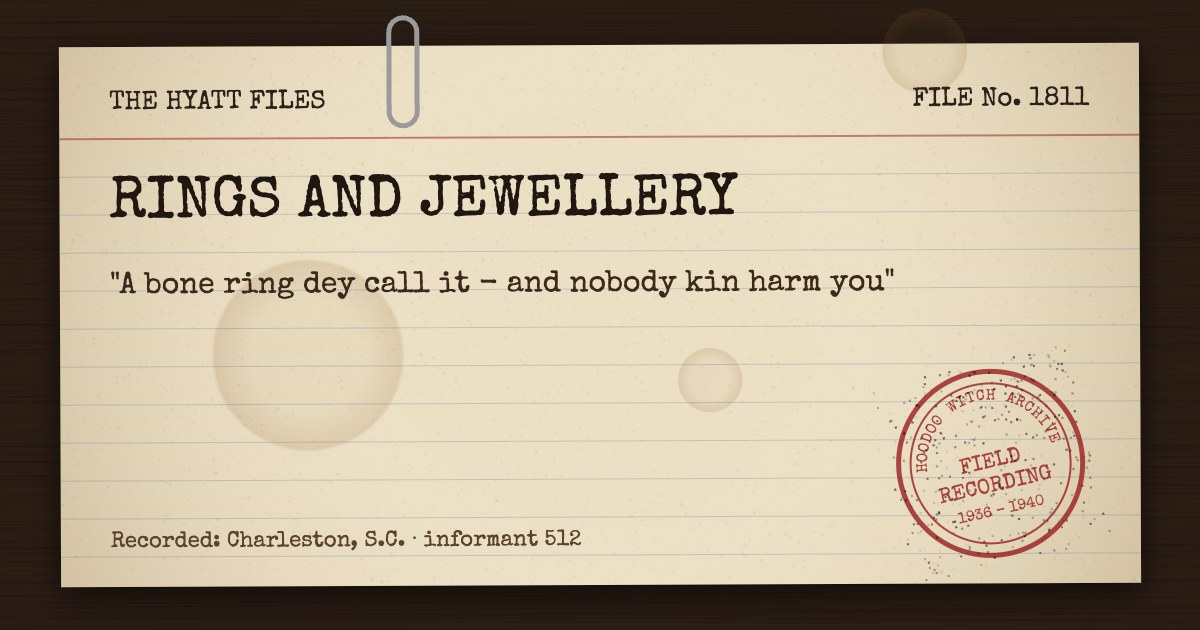
The bone ring was darker work. A Charleston doctor said to get the bone from the undertaker: “you speak to de undertaker when he begin embalmin’ a body.” He sold the rings for five dollars apiece (Hyatt 1811 · Charleston, S.C. · informant 512).
The variations
- The horseshoe-nail ring, worn for luck, was one of the most common (Hyatt 1345 · Sumter, S.C. · informant 1378; Hyatt 2010 · Richmond, Va. · informant 361; Hyatt 12208 · Savannah, Ga. · informant 1269).
- A ring set with the wearer’s birthstone was carried for gambling luck alongside lodestone (Hyatt 1836 · Vicksburg, Miss. · informant 735).
- Around Charleston, big earrings were blessed by the conjure man and worn always for luck, sometimes set with pearls (Hyatt 856 · Fredericksburg, Va. · informant 43).
- Hyatt noted a Richmond belief that a girl could put a man’s hair in a finger ring to break him up from another woman (Hyatt 12032 · Richmond, Va.).
- For a killer facing the judge, a New Orleans informant described digging up the murdered man, taking the five fingernails of his left hand, boring each with a heated needle and stringing them into a necklace to wear in court (Hyatt 7333 · New Orleans, La. · informant 860).
Testing and curing
Silver showed poison. A woman in New York wore a silver bracelet for ten years, because any poison laid for her would turn it black (Hyatt 607 · New York City · informant 5).
A Fredericksburg doctor stood his silver ring in a glass of milk and gave it to a woman about to go to the asylum. The milk did not turn black, so he said she was not hurt inside (Hyatt 612 · Fredericksburg, Va. · informant 69).
Gold cured a sty. Humpadee, a Richmond root doctor, said to take a good gold ring and “rub that eye down like that [demonstrates] 9 mornings, 9 times” (Hyatt 13235 · Richmond, Va. · informant 404).
The doctors wore it too. Hyatt recorded root doctors known for their large earrings, among them a man on Deal Island who called himself High John the Conquer (Hyatt 846 · Deal Island, Md.).
In their own words
“A bone ring dey call it – and nobody kin harm you”
(Hyatt 1811 · Charleston, S.C. · informant 512)
“If any poison is laid for her, it will go in that bracelet and turn it black”
(Hyatt 607 · New York City · informant 5)
“Dey use a horseshoe nail fo’ a ring. Dat’s good luck, wear it fo’ a ring.”
(Hyatt 12209 · Brunswick, Ga. · informant 1224)
“the cunjure man blesses these big earrings and they’re supposed to wear them all the time.”
(Hyatt 856 · Fredericksburg, Va. · informant 43)
How it’s worked today
Rings, bracelets and pendants are still dressed with oil and prayed over as protection pieces, and silver jewellery is still watched for tarnish as a sign that work has been laid.
Horseshoe-nail rings are still made and sold for luck, and coin and charm jewellery remains a common way to carry a hand in plain sight.
In the Student Library: Minerals and curios · Hoodoo dictionary · Where Hyatt recorded
Learn the work
Hoodoo Witch Certification Course
The course covers protection pieces, carried and worn charms, and how they are made and dressed.
Source: Harry Middleton Hyatt, Hoodoo – Conjuration – Witchcraft – Rootwork, 5 vols., 1970-1978. Numbers refer to Hyatt’s own item numbers; the town and informant number follow. Written by Hoodoo Witch in our own words, with short quotations from Hyatt’s informants for reference.