
Photographs and Pictures
“Yes, they shot her in de eye. That’s the reason that she wear dat piece over her eye.” A Norfolk informant was talking about a woman whose photograph had been stolen, and what was done to it (Hyatt 31 · Norfolk, Va. · informant 471).
In hoodoo a photograph is not a likeness. It is the person. Whatever happens to the picture, being shot, buried, drowned or turned to the wall, was believed to happen to the one whose face is on it.
What it is
Hyatt himself filed the photograph alongside hair, breath, clothes, bathwater and a written name: things that carry a part of the spirit, and so stand for the whole of it.
By the 1930s, when most of his interviews were recorded, cheap photographs had put this power in almost every household. Informants talked of tintypes, studio portraits, snapshots, and even a face cut from the newspaper.
Because a picture could be stolen from a mantelpiece or begged from a friend, it was one of the easiest links to get, and one of the most feared to lose.
What Hyatt’s informants said
The plainest rite was the simplest: “they kin take your photograph and shoot it – shoot it.” (Hyatt 31 · Norfolk, Va. · informant 471).
Turning a picture over was enough to work on the mind. A Brunswick informant said a photograph kept face down on a mantel would leave you with no presence of mind to go to work or finish anything you started (Hyatt 2202 · Brunswick, Ga. · informant 1242).
Brunswick also gave Hyatt a drinking spell. A picture of a man who had never touched whiskey was turned down over a small glass of it, left until the fumes faded the photograph, “an’ dat person will drink hisself to death.” (Hyatt 79 · Brunswick, Ga. · informant 1175).
Death and burial work
Much of the photograph material is grave work, and it is described without hesitation.
- A picture laid on the face of a corpse in its casket, so the living person would waste away as the body did (Hyatt 1789 · Jacksonville, Fla. · informant 559).
- A photograph cut into the shape of an old-fashioned coffin and buried face down in a new grave, in the Name of Jesus (Hyatt 1790 · Memphis, Tenn. · informant 1540).
- A photograph nailed into a box with nine red beans, nine brass tacks, nine needles and nine pins, then weighted and sunk from the ferry in the middle of the river (Hyatt 1792 · New Orleans, La. · informant 834).
- A landlord’s picture cut from the Picayune, laid in a cigar-box coffin and buried under the floor behind the piano, so the tenant could live there more than a year without paying rent (Hyatt 1787 · New Orleans, La. · informant 824).
Bringing someone back
Photographs worked for love as well. A woman whose man had gone could turn his picture upside down and burn green and yellow candles over it to pull his mind back to her (Hyatt 2891 · Mobile, Ala. · informant 692).
A Memphis informant set the photograph beside a glass of water and a black candle with his name written on it (Hyatt 2814 · Memphis, Tenn. · informant 1527). Others hung the picture with its face to the wall and burned lights against it (Hyatt 2870 · New Orleans, La. · informant 841).
In their own words
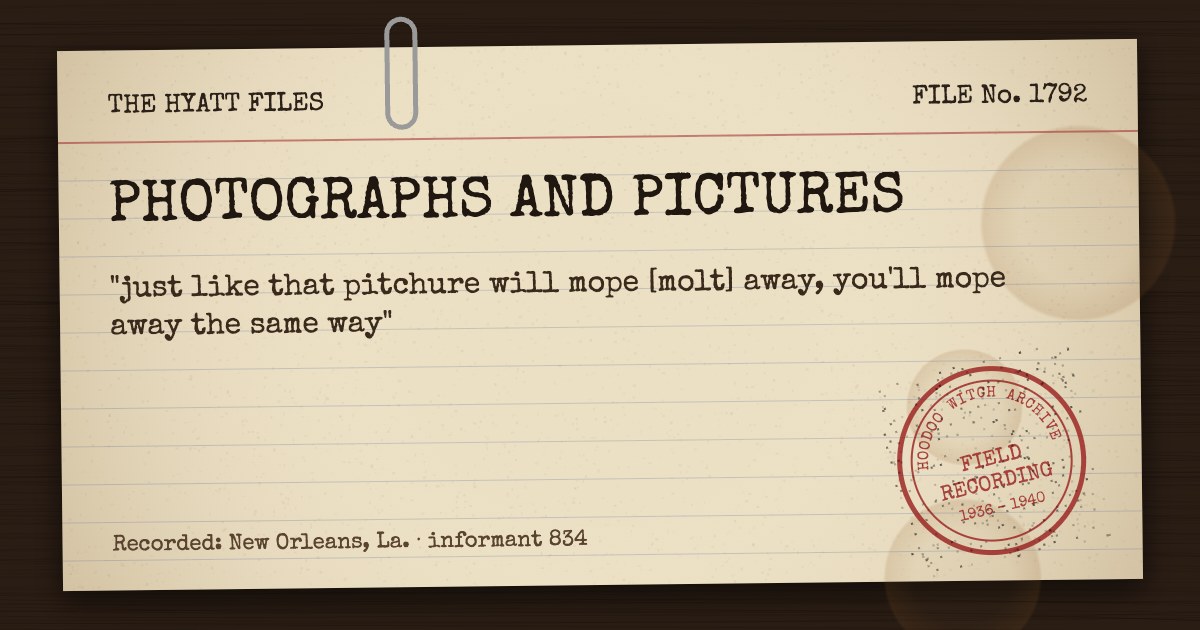
“just like that pitchure will mope [molt] away, you’ll mope away the same way”
(Hyatt 1792 · New Orleans, La. · informant 834)
“dis person will jest pine away of dat picture.”
(Hyatt 1789 · Jacksonville, Fla. · informant 559)
“bury him in dat grave on his face, a new grave , not a old one”
(Hyatt 1790 · Memphis, Tenn. · informant 1540)
How it’s worked today
Photographs are now the most common personal link in rootwork, simply because everyone has them. Printed phone pictures and social media images are used the way Hyatt’s informants used tintypes and studio portraits.
Workers dress candles over photographs, seal them in honey or vinegar jars, freeze them, bury them in graveyard dirt, or turn them face down and upside down to confuse and overturn. Many still say an original print the person has handled carries more than a copy.
Learn the work
The course covers baneful work with photographs and other personal links, from crossing and confusion to graveyard work.
Source: Harry Middleton Hyatt, Hoodoo – Conjuration – Witchcraft – Rootwork, 5 vols., 1970-1978. Numbers refer to Hyatt’s own item numbers; the town and informant number follow. Written by Hoodoo Witch in our own words, with short quotations from Hyatt’s informants for reference.