
Healing and Root Medicine
The root doctor in Hyatt’s volumes was a healer as much as a worker. The same man who took off a fix could boil you a tea for rheumatism, and often the two were one job.
His medicine came from the woods, the pasture and the yard: roots, bark, berries, animal grease, and things most doctors would never touch.
What it is
Hyatt’s informants split sickness in two. There was natural sickness, which a medical doctor might treat. And there was the other kind, put on you by somebody.
A Little Rock man gave a remedy for use “if a person is crazy or anything, yo’ know, an’ it’s not a natch’ al disease” (Hyatt 1228 · Little Rock, Ark. · informant 896). The cure was a tea of dog manure, left until it turned white.
The root doctor did not always draw that line. A Wilmington informant’s doctor promised a cure for anyone hurt by witchcraft, “if it’s rheumatism or your blood or somepin like that, I can git you all right.” (Hyatt 560 · Wilmington, N.C. · informant 295).
What Hyatt’s informants said
Teas were the backbone. Near Fredericksburg, a conjure man went into the woods for “pokeberry roots and red oak bark and saxafras [sassafras] roots and cooked it together and made a tea” for rheumatism, the same remedy his father had cured himself with (Hyatt 576 · Fredericksburg, Va. · informant 71).
In New Orleans, sassafras was boiled as the first step of a cure, to purify the blood before the rest of the work (Hyatt 701 · New Orleans, La. · informant 832).
Boiling down mattered. Medicines went into a quart of water and were boiled down to a pint, what Hyatt called the magic of diminishing amount (Hyatt 603 · Florence, S.C. · informant 1283).
The remedies
- Bull nettle tea, drunk for thirty days or more, for syphilis (Hyatt 1145 · Little Rock, Ark. · informant 892).
- Two buckeyes carried in the pockets until the hulls came off, for rheumatism the doctors couldn’t cure (Hyatt 1144 · Mobile, Ala. · informant 656).
- Buzzard grease rubbed on stiff joints, and on a child who never walked (Hyatt 1148 · St. Petersburg, Fla. · informant 1088; Hyatt 1151 · Brunswick, Ga. · informant 1206).
- Dirt-dauber nest tea for measles and whooping cough (Hyatt 1215 · New Orleans, La. · informant 1566).
- A silver quarter, its milled edge scraped off, boiled from two quarts down to a pint and drunk as a tea for a hurt hand (Hyatt 865 · Wilmington, N.C. · informant 293).
- Cow manure, caked and brown from the pasture, made into a tea with beef gall for feet poisoned through the shoe (Hyatt 1202 · Vicksburg, Miss. · informant 752).
Taking out what was put in
Much root medicine was counter-work. Where live things had been put in the body, teas brought them out.
In Sumter, dog fennel and dogwood root teas were drunk to bring out the insect or whatever had been put inside (Hyatt 1236 · Sumter, S.C. · informant 1362). In Fayetteville, green chinaberries were boiled into a tea to get a snake out (Hyatt 690 · Fayetteville, N.C. · informant 1390).
In Petersburg, bloodroot and High John the Conqueror were made into a tea, then a salve with table salt, and rubbed from neck to feet to throw the spell off (Hyatt 1128 · Petersburg, Va. · informant 444).
In their own words
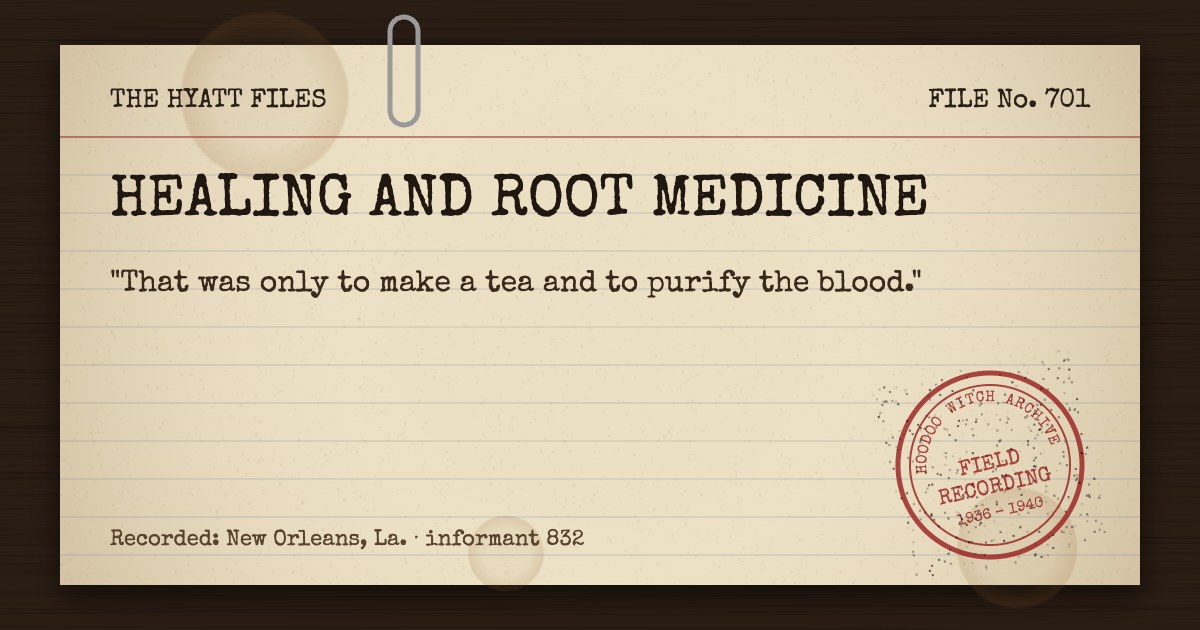
“That was only to make a tea and to purify the blood.”
(Hyatt 701 · New Orleans, La. · informant 832)
“Yo’ kin take dirt daubers an’ make a tea out of it an’ cure de measles, whoopin’ cough of a chile”
(Hyatt 1215 · New Orleans, La. · informant 1566)
“it keeps yo’ jints [joints] loosened, it’s good for rheumatism.”
(Hyatt 1148 · St. Petersburg, Fla. · informant 1088)
“take de root an’ make a tea of it, an’ dat insec’ or whatsomevah it ’tis dey got down in yuh”
(Hyatt 1236 · Sumter, S.C. · informant 1362)
How it’s worked today
Root medicine survives in Southern families and among rootworkers who still treat both kinds of sickness. Sassafras, pokeberry and bloodroot are still gathered, and spiritual cleansing teas and baths are still given alongside, or after, a medical doctor’s treatment.
The question Hyatt’s informants asked, natural or put on, is still the first question many root doctors ask a client.
In the Student Library: Roots and herbs · Roots and curios on the shelf · Where Hyatt recorded
Learn the work
Hoodoo Witch Certification Course
The course covers the root doctor’s work, from roots and herbs to taking off a fix and healing what it left.
Source: Harry Middleton Hyatt, Hoodoo – Conjuration – Witchcraft – Rootwork, 5 vols., 1970-1978. Numbers refer to Hyatt’s own item numbers; the town and informant number follow. Written by Hoodoo Witch in our own words, with short quotations from Hyatt’s informants for reference.