
Lamps and Lamp Work
“You burning that candle on her and she burning that lamp on you.” A New Orleans worker said it plainly: one woman has a lamp going with your name in it, so you answer her with a black candle, and the candle will bust her lamp (Hyatt 2956 · New Orleans, La. · informant 837).
Before candles were cheap and everywhere, the lamp was the light of conjure. Hyatt’s informants in the 1930s burned plain kerosene lamps, small tin lamps and little glass bowls, and they spoke of burning a lamp on someone the way others spoke of throwing a trick.
What it is
Lamp work is slow, steady fire. A name, a petition or a personal item goes into the oil bowl or under the lamp, the wick is turned low, and the lamp is kept burning for a set number of days or until the work is done.
The light is not decoration. It is the engine. As long as the lamp burns, the work is on the person.
The lamp itself was ordinary. Asked what kind, a St. Petersburg man answered, “Jest a ordinary burning lamp, oil lamp.” (Hyatt 1659 · St. Petersburg, Fla. · informant 977)
What Hyatt’s informants said
Most lamp rites in the volumes are drawing work: bringing a man home. “Well, if her husband is running around, she burn a lamp on him.” That Vicksburg woman put incense in the lamp and burned it low by day and high by night (Hyatt 12218 · Vicksburg, Miss. · informant 737).
In New Orleans, a woman wrote the man’s name nine times, wrote her own over it, and pinned the paper to the wick with steel dust, lodestone and sugar in the bowl. She lit it with the Lord’s Prayer and the holy names. “Don’t let it go out an’ he’ll come back.” (Hyatt 8592 · New Orleans, La. · informant 798)
Hyatt himself noted that small lamp rites were common in New Orleans, where workers used little tin lamps and spoke directly to the flame (Hyatt 4262 · New Orleans, La. · informant 838).
The variations
- Name in the oil. The name written nine times, folded towards the worker, dropped into the oil bowl. Many informants kept nine days as the term.
- Sugar. A pinch in the oil to sweeten. One informant said a lamp burned nine mornings with your name and sugar would make you go their way, whatever they wanted (Hyatt 2956 · New Orleans, La. · informant 837).
- Red flannel. A piece laid over the name to hide it from anyone looking (Hyatt 8604 · New Orleans, La. · informant 814).
- The dearest name. In Memphis, the absent man’s name was written with the name of the person he loved most, living or dead (Hyatt 8596 · Memphis, Tenn. · informant 973).
- The photograph. A picture turned upside down in a dark room with a lamp turned low beside it. Hyatt explained the reversal confuses the spirit of the photo (Hyatt 8189 · Charleston, S. Car. · informant 536).
What it was used for
- Return and control. Drawing back a husband or lover, or bending someone to the worker’s will.
- Business. A St. Petersburg storekeeper burned five or nine customers’ names in a kerosene lamp for nine days and swept only towards the back of the shop (Hyatt 2434 · St. Petersburg, Fla. · informant 1039).
- Thieves. The thief’s name went into a lamp set in a dark place; when the oil burned down to the name, the goods came back (Hyatt 8918 · New Orleans, La. · informant 831).
- Harm. One New Orleans informant put the victim’s name in the lamp, called the spirit of someone who had lived and died bad, and buried the name in a snuffbox in that spirit’s grave (Hyatt 8587 · New Orleans, La. · informant 1558).
- Protection. Against a spirit that rode him at night, a man laid new lumber across the door and set a lamp turned low about three and a half feet from it (Hyatt 1659 · St. Petersburg, Fla. · informant 977).
Counter-work
A lamp could be fought. The answer recorded in New Orleans was to write the worker’s name nine ways, set a black candle on it in the north corner of the house, and burn it nine mornings until the enemy’s lamp burst (Hyatt 2956 · New Orleans, La. · informant 837).
In their own words
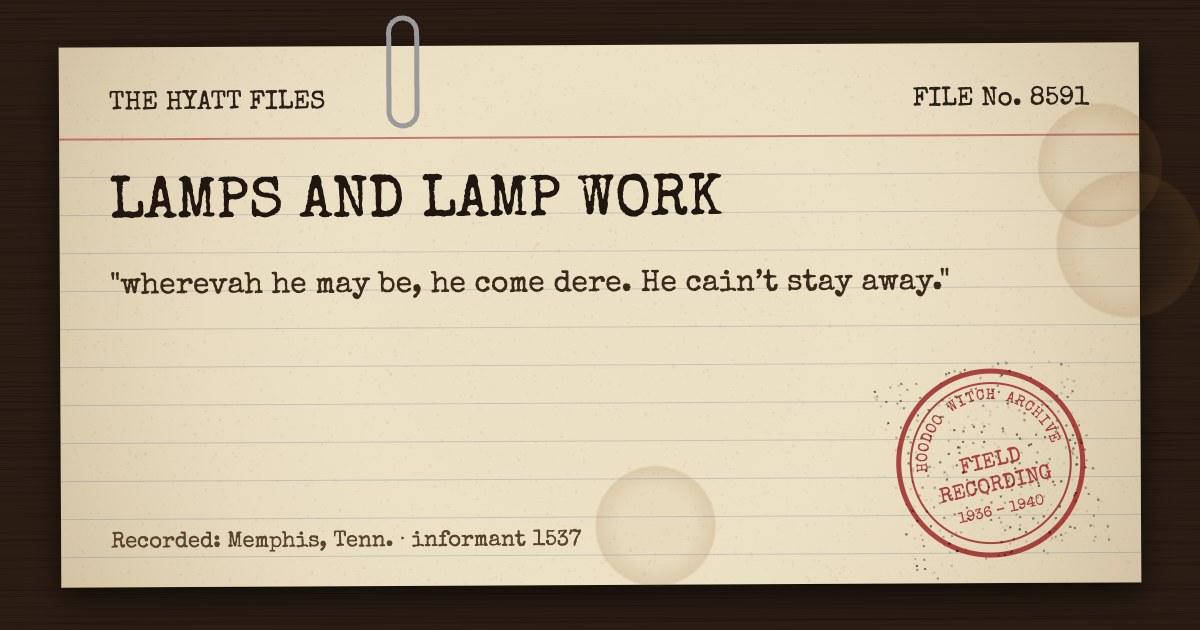
“wherevah he may be, he come dere. He cain’t stay away.”
(Hyatt 8591 · Memphis, Tenn. · informant 1537)
“yo’ burn it night an’ day, ’cause yore gon’a have customers cornin’ in all times of de night.”
(Hyatt 806 · Savannah, Ga. · informant 1261)
“Dey call ’em scent [saint] lamps.”
(Hyatt 8916 · Memphis, Tenn. · informant 938)
How it’s worked today
Lamp work is still a core method in Southern conjure and New Orleans practice. Workers use glass oil lamps, vigil lamps and saint lamps, with the petition under the burner or in the bowl and the wick kept low.
The old rules carry through: names written nine times, sugar for sweetness, lodestone and steel dust for drawing, nine-day terms, and the lamp kept out of sight. Many workers still keep a lamp burning on a client’s case for weeks, refilling the oil and reading the flame as Hyatt’s informants did.
Learn the work
Hoodoo Witch Certification Course
The course teaches lamp and light work in full, from preparing the oil and petition to timing, tending and reading the flame.
Source: Harry Middleton Hyatt, Hoodoo – Conjuration – Witchcraft – Rootwork, 5 vols., 1970-1978. Numbers refer to Hyatt’s own item numbers; the town and informant number follow. Written by Hoodoo Witch in our own words, with short quotations from Hyatt’s informants for reference.