
Cards and Fortune Telling
A Jacksonville man told Hyatt that when he was twelve, people would come to his house and “git mah daddy to let me come cut cards fo’ ‘um”. It was a gift, he said, and it left him when he took to cursing and lying (Hyatt 569 · Jacksonville, Fla. · informant 549).
Cards ran all through Hyatt’s interviews. Root doctors read them, clients paid for them, gamblers dressed them. Hyatt called playing cards hoodoo’s greatest method for revealing a person’s past, present and future.
What it is
The tool was the ordinary 52-card deck, the same one used for skin games and poker. No special fortune-telling deck appears in these accounts.
The person who used it was called a reader or a fortune teller. Hyatt noted that most professional workers were also fortune tellers, and that, as the doctors saw it, the information came from spirits.
He also noted a detail of his own fieldwork. Informants several times asked him for a deck to demonstrate, but he never carried one, in case he was arrested and it was found on him (Hyatt 602 · New Orleans, La. · informant 823?).
What Hyatt’s informants said
A New Orleans doctor, whom Hyatt rated excellent, gave him the meaning of each suit. Spades were disappointment and sad dissension in the family. Hearts were love and friendship. Diamonds were money. And “clubs is drinks and noise and coming of plenty people.” If the nine of clubs turned up from the top, you were overcome (Hyatt 602 · New Orleans, La. · informant 823?).
Another New Orleans worker used the deck to find a thief. Shuffle, cut three times, turn a card face up: “If it’s a man, it goin’ tuh be a jack; if it’s a woman, it goin’ tuh be a queen”. The suit then showed whether the thief was Black, white or light-skinned (Hyatt 7236 · New Orleans, La. · informant 823).
A Norfolk doctor said he generally told everything with cards, and gave a boiling-coin method for those who could not read them (Hyatt 614 · Norfolk, Va. · informant 466).
What the cards were used for
- Diagnosis. Whether a sickness was natural, who had put the work down, and what it was. A Mobile woman took a jar she found to a reader, who shook it, studied it, then went to another room and came back with the cards. Shuffling with a hand full of cards, she named the woman’s husband as the one doing it (Hyatt 975 · Mobile, Ala. · informant 693).
- Court cases. A Vicksburg woman paid a card reader a dollar. The reader told her she could win a suit, if the reader helped, and sent her on to a lawyer (Hyatt 875 · Vicksburg, Miss. · informant 716).
- Thieves. The sex and colour of the person who stole from you (Hyatt 7236 · New Orleans, La. · informant 823).
- Trouble and fortune. Whether a client would get out of trouble, and at what cost; whether money, love or sorrow was coming (Hyatt 602 · New Orleans, La. · informant 823?).
Cards at the gambling table
Cards were also a gambler’s tool, and that side of them carried its own dark work. A Sumter informant said that to become a professional gambler you took a deck to the cemetery just after midnight, straddled the first man’s grave and waited for someone to come and play with you (Hyatt 353 · Sumter, S. Car. · informant 1377).
A Brunswick informant said gamblers dried a toadfrog, kept the dust in their pocket and worked it through the cards while they shuffled, for luck (Hyatt 1885 · Brunswick, Ga. · informant 1240).
In their own words
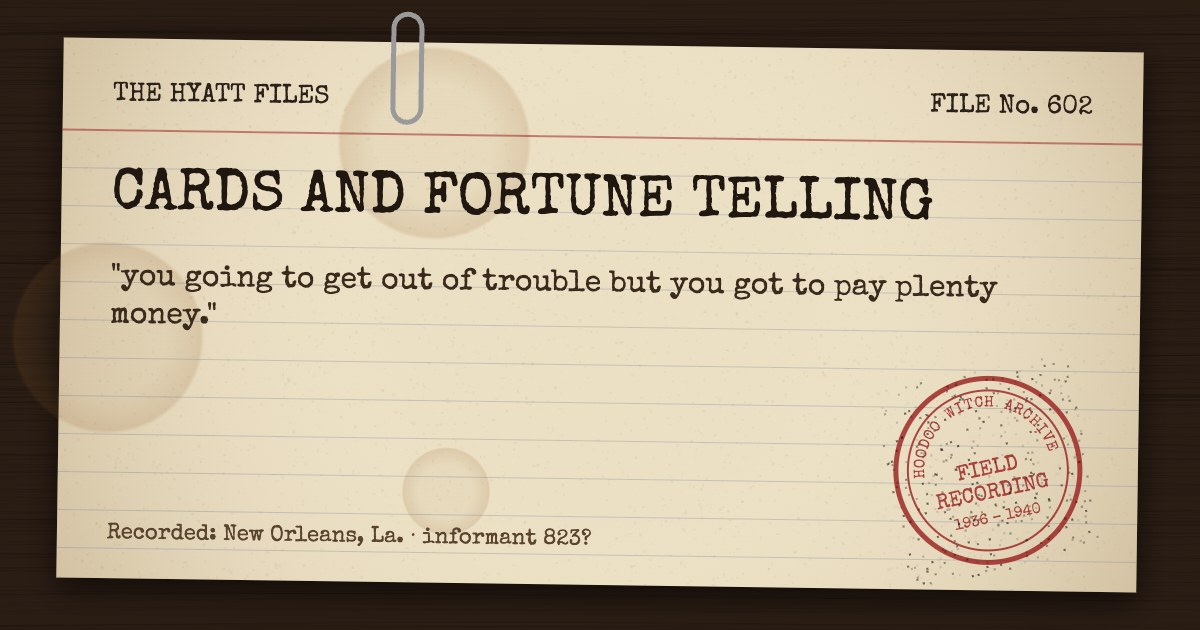
“you going to get out of trouble but you got to pay plenty money.”
(Hyatt 602 · New Orleans, La. · informant 823?)
“I read cards – find out practically anything that I want to know”
(Hyatt 614 · Norfolk, Va. · informant 466)
“She came back with a deck of cards and she begin to shuffle the cards”
(Hyatt 975 · Mobile, Ala. · informant 693)
“No chance for good.”
(Hyatt 602 · New Orleans, La. · informant 823?, on drawing a spade)
How it’s worked today
Reading with a plain playing-card deck remains a living Southern practice, often learned in the family, as it was for the Jacksonville boy.
The suit meanings Hyatt recorded are still the backbone of most readings: hearts for love, diamonds for money, clubs for company and quarrels, spades for trouble and grief. Many workers still read first and work second, using the cards to find out who laid a trick and what it was before deciding on a cure.
Gamblers still dress their decks and carry luck hands at the table.
Learn the work
Hoodoo Witch Certification Course
The course teaches card reading as a rootworker uses it: for diagnosis, for finding who laid the work, and for deciding what comes next.
Source: Harry Middleton Hyatt, Hoodoo – Conjuration – Witchcraft – Rootwork, 5 vols., 1970-1978. Numbers refer to Hyatt’s own item numbers; the town and informant number follow. Written by Hoodoo Witch in our own words, with short quotations from Hyatt’s informants for reference.