Gambling Luck
Wherever money changed hands over cards and dice, hoodoo went too. Hyatt’s informants talked about gambling more than almost any other kind of luck, and they talked about it as working people who sat at real tables: the payday crap game, the Saturday-night skin game, the policy slip bought on a street corner.
A gambling hand was not a vague charm for good fortune. It was a weapon carried into a contest against other players, many of whom were carrying hands of their own.
What it is
The gambling hand is a mojo, toby or packet made specifically to win at games of chance. It was usually sewn in red flannel, carried in the pocket, fed with whiskey or perfume, and rubbed on the hands before play.
Alongside the hands sat a whole body of gambling tricks: dice that had been worked on, frogs carried into the game, and dream work for picking numbers.
The games
- Dice – craps, shot on the ground around work camps and paydays.
- Skin – a card game. One St. Petersburg man explained it for Hyatt, cutting the deck so each player has a card, then betting on whose card falls first: “Dey call dat skin game. An’ yo’ wanta be lucky now.” (Hyatt 1874 · St. Petersburg, Fla. · informant 1008)
- Policy, or the numbers – the illegal lottery that ran through Black neighbourhoods in Southern and Northern cities alike. Hyatt himself recorded a hand bought in Philadelphia for choosing policy numbers.
What Hyatt’s informants said
The ingredients were the familiar luck materials, put to a hard purpose. A Wilson, North Carolina informant mixed magnetic sand, Adam and Eve root and lodestone in red flannel (Hyatt 2094 · Wilson, N. Car. · informant 1513). In Brunswick, Georgia, a buckeye from the woods was enough (Hyatt 1760 · Brunswick, Ga. · informant 1192).
Others went much further. In Ocean City, Maryland, the dice themselves came out of the graveyard: “You take a bone from a dead man’s right hand . You go to the cemetery and dig them up, and you make a pair of dice out of them .” (Hyatt 1820 · Ocean City, Md. · informant 14)
In Memphis, buzzard fat was buried, dug up after three days and cooked down to lard, then kept in a box and rubbed on the left hand for fast luck at play (Hyatt 1763 · Memphis, Tenn. · informant 1547).
For the numbers, the work turned to dreams. A Memphis informant kept John the Conqueror root and perfume with his chosen numbers under his head at night, to dream the winning play: “Ah’ve caught a-plenty money playin’ policy.” (Hyatt 734 · Memphis, Tenn. · informant 933)
Variations
- The frog – a live toadfrog carried into the game. In Jacksonville a player wrote his numbers on the frog’s belly in indelible pencil (Hyatt 575 · Jacksonville, Fla. · informant 549).
- Worked dice – dice soaked in urine, salt, pepper or lodestone, kept shut away until the next game.
- The crossroads – a Fayetteville man shook his dice at the crossroads before sunrise, in the names of the Father, Son and Holy Ghost, until the sun came up (Hyatt 354 · Fayetteville, N. Car. · informant 1415).
- The egg – in Brunswick, the names of everyone in the game were written on a hen’s egg and carried in the pocket (Hyatt 1851 · Brunswick, Ga. · informant 1197).
Killing the other man’s hand
Because everyone at the table might be carrying something, there was counter-work. Garlic in the pocket would kill the other player’s hand (Hyatt 1910 · New Orleans, La. · informant 859). In St. Petersburg, table salt dropped on the head of a luckier player did the same job (Hyatt 2264 · St. Petersburg, Fla. · informant 991).
Buying a hand
Gambling hands were a trade. Informants bought them for five dollars, fifteen dollars, or on trial, and some were cheated. Others told of a reader who demanded half the winnings, and what happened when it went unpaid.
In their own words
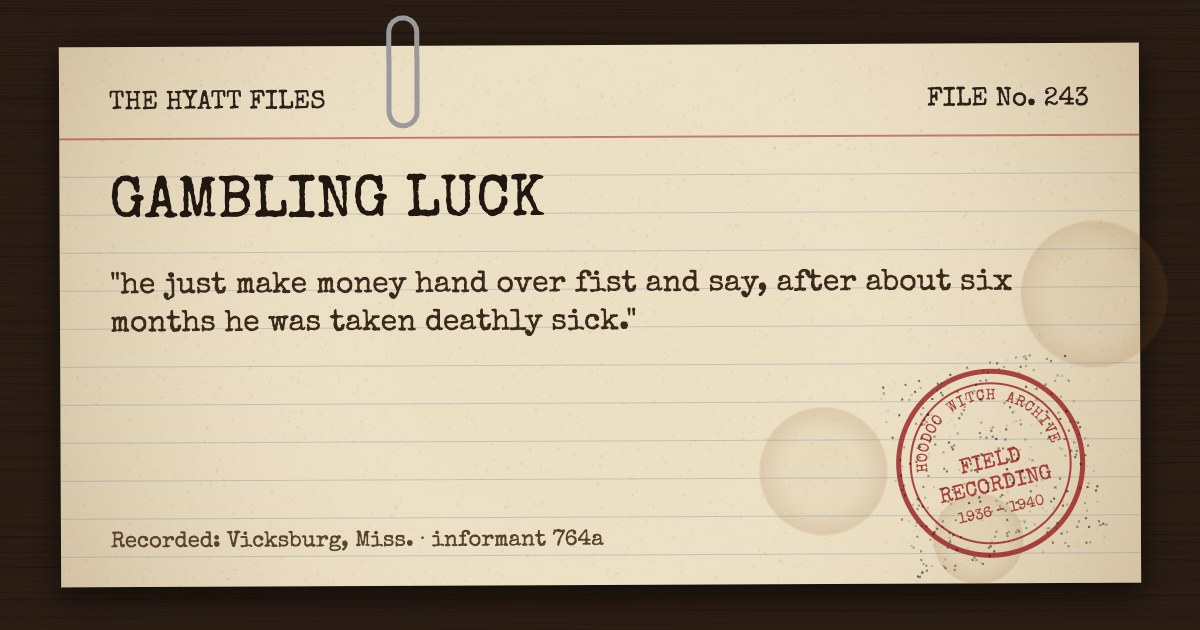
“he just make money hand over fist and say, after about six months he was taken deathly sick.”
(Hyatt 243 · Vicksburg, Miss. · informant 764a)
“Pee on a pair of dice an’ shet it up in a airtight box”
(Hyatt 1835 · Fayetteville, N. Car. · informant 1415)
“Take a toadfrog an’ put him in yore right pocket an’ go to a skin game.”
(Hyatt 1883 · Fayetteville, N. Car. · informant 1407)
“One hand I bought , it was full of charcoal – there wasn’t nuthin to dat one .”
(Hyatt 1836 · Vicksburg, Miss. · informant 735)
How it’s worked today
Gambling hands are still made and sold. The red flannel bag remains standard, and the core materials are much the same: lodestone with magnetic sand, John the Conqueror, Adam and Eve root, buckeye, five-finger grass and a silver dime.
Hands are still fed, now usually with whiskey or a luck oil, and players still rub their hands with oil or cologne before cards, dice, bingo or the lottery. Dream books and numbers work carry the policy tradition into today’s state lotteries.
Learn the work
Hoodoo Witch Certification Course
The course teaches how luck hands are built, dressed and fed, and how this work fits into rootwork for money and luck as a whole.
Source: Harry Middleton Hyatt, Hoodoo – Conjuration – Witchcraft – Rootwork, 5 vols., 1970-1978. Numbers refer to Hyatt’s own item numbers; the town and informant number follow. Written by Hoodoo Witch in our own words, with short quotations from Hyatt’s informants for reference.